Svalbard in Winter vs Summer: Which Trip Do You Actually Want?
Winter and summer in Svalbard are two different holidays sharing one island. Compare the tours, the light, the cost and the cancellation risk before you pick your dates.
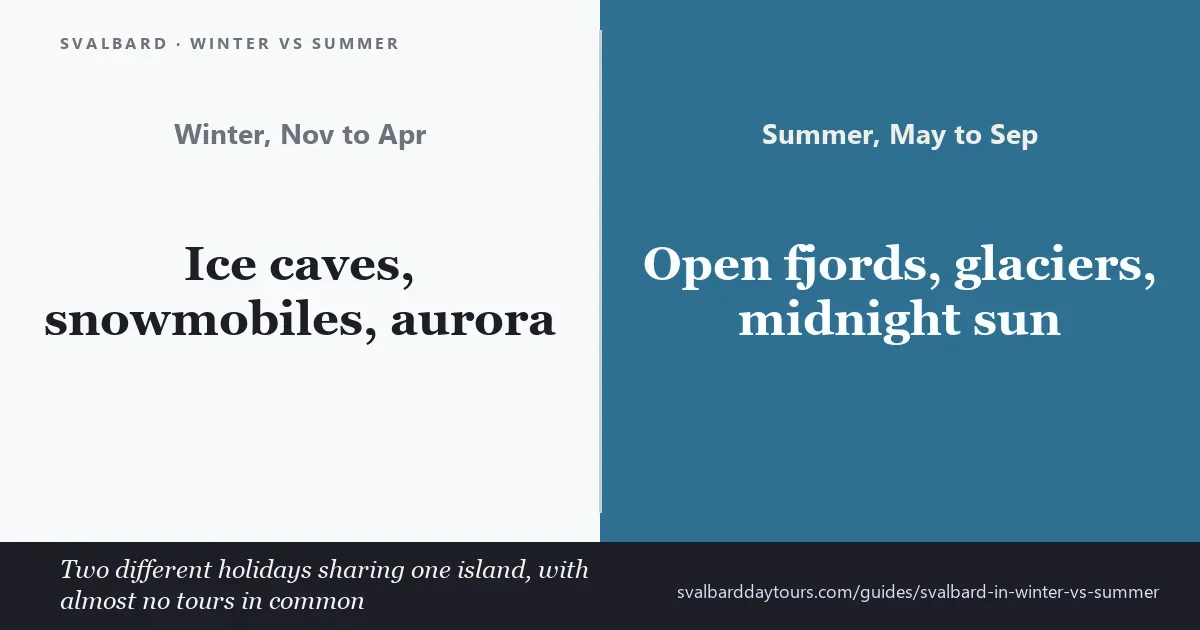
People ask which season is better in Svalbard, and the honest answer is that they are not competing. They are two different holidays that happen to share an island, and almost no tour appears in both. Winter gives you snowmobiles, ice caves and the aurora. Summer gives you open fjords, glacier fronts, birdlife and 24-hour daylight. There is no month that gives you all of it, and no amount of budget changes that.
So the question is not which is better. It is which of those two lists you came for.
Check Availability
What each season actually gives you
Winter, roughly November to April. The archipelago freezes solid and opens up on land. Snowmobiles become the way to travel; the ice cave trips become possible because the meltwater channels inside the glaciers have frozen. The aurora runs from about late September to mid-March. Between about 11 November and 30 January the sun does not rise at all, and the town spends the day under a long blue twilight.
Summer, roughly late May to September. The fjords open and the boats start. Everything on water — the Isfjorden boat trip, the longer runs to Pyramiden and the Nordenskiöld glacier, Barentsburg, glacier cruises — belongs to these months. The tundra greens, the bird cliffs fill from late May to mid-August, and from around 20 April to 22 August the sun never sets. July, the warmest month, averages about 4.7 °C.
Neither season is a diluted version of the other. They are simply disjoint.
The cost difference is not what you expect
Winter is not the cheap season and summer is not the expensive one. Prices in this catalogue track the shape of the day, not the month:
| Winter | Summer | |
|---|---|---|
| Cheapest tour | Town and Seed Vault, $144, 2 hr | Same tour, same price |
| Signature tour | Ice cave by snowmobile, $480, 3.5 hr | Isfjorden boat trip, $309, 2.5 hr |
| Cost per hour | Highest — machines and fuel | Lower — but the day is much longer |
| Flights and beds | Generally cheaper | Peak season, especially July |
The real cost difference is in flights and accommodation, not tours. If you are optimising for budget, the shoulder months either side of July do more for you than switching season entirely.
Cancellation risk runs the other way
This is the part most comparisons miss. Winter tours look riskier and mostly are not.
Summer’s flagship product is a two-and-a-half-hour closed-boat trip across Isfjorden, and Isfjorden can turn from flat to genuinely rough within an hour. That makes it the booking most likely to move in this catalogue, so put it early in your stay and leave a spare day behind it.
Winter’s flagship, the snowmobile ice cave run, is shorter, closer to town, and less exposed to sea state. What it is exposed to is your own paperwork: you must physically bring a valid driving licence to ride, and without one there is no refund. That is a risk you control.
In both seasons the same defence applies — book the fragile tour early in your stay, and keep the coal mine tour in reserve. It runs every month and nothing above ground can cancel it.
Which season for which traveller
Book winter if you want the aurora, you want to ride a snowmobile, you want to stand inside a glacier, or you specifically want the polar night — which is a genuinely strange and worthwhile experience rather than merely a dark one.
Book summer if you want to get out on Isfjorden, see bird cliffs from the water, photograph seabirds and reindeer on green tundra, or you simply cannot face −15 °C. Also book summer if mobility is a concern: no ice underfoot, and the boat tours involve less standing around in the cold than the winter equivalents.
Book a shoulder month if you want both lists partly satisfied. Late September and October still have boats and have the aurora back. Late March and April still have snow and have the light back. Those two windows carry the widest range of bookable tours in the year — the month-by-month guide sets out exactly what is running when.
What does not change
Three things are constant whichever season you pick.
You cannot leave the settlement without an armed guide — that is Norwegian law, not operator preference, and it is why the guided day tour is the mechanism by which you see Svalbard at all rather than a convenience.
Groups are small in both seasons. Eight on the boat, four per guide in the ice cave, single figures on most walks. There is no walk-up market in a town of about 2,500 people with a limited number of licensed guides, so book before you fly either way.
And it is cold in July. Four degrees with wind off the fjord is not a summer temperature anywhere else. Our packing guide covers both seasons, and the summer list is shorter but not by as much as you would think.
Frequently Asked Questions
Is Svalbard worth visiting in winter?
Yes, and for a specific reason: three of its most distinctive experiences — the ice caves, the snowmobiles and the polar night — exist only then. If you want any of those, winter is not a compromise, it is the only option.
Is Svalbard worth visiting in summer?
Yes, if what you want is on the water or on the tundra. Pyramiden, the glacier fronts, the bird cliffs and the wildlife photography all peak between late May and September, and none of them are available in February.
Can you see the northern lights in summer in Svalbard?
No. Between around 20 April and 22 August the sun never sets, so the sky is never dark enough. The aurora season runs from about late September to mid-March.
Can you go on a snowmobile in summer in Svalbard?
Not in the way you are imagining. Snowmobile tours from Longyearbyen run on snow and ice, roughly November to April. A handful of operators run summer machines on remaining glacier snow, but they are not part of the standard day-tour catalogue and they are not the same experience.
Which season is better for wildlife?
Summer, on balance. Reindeer and Arctic fox are present year-round and the wildlife safari runs in both, but the seabird colonies are only busy from late May to mid-August, and whales and walrus are seen from the boats rather than from land. Winter’s advantage is fox in white winter coat against snow, which is the photograph people come back for.
Stand at the Door of the Global Seed Vault
Two hours by car to the concrete wedge in the mountainside, out through Adventdalen where the reindeer graze, and round Longyearbyen's mining heritage. Hotel pickup and a warm drink included — and it runs every month of the year.
Check Availability & Book