The Best Time to Visit Svalbard for Day Tours
A month-by-month guide to what is actually bookable in Svalbard — ice caves, boats, aurora and midnight sun — with the light, the temperature and the tour season for each.
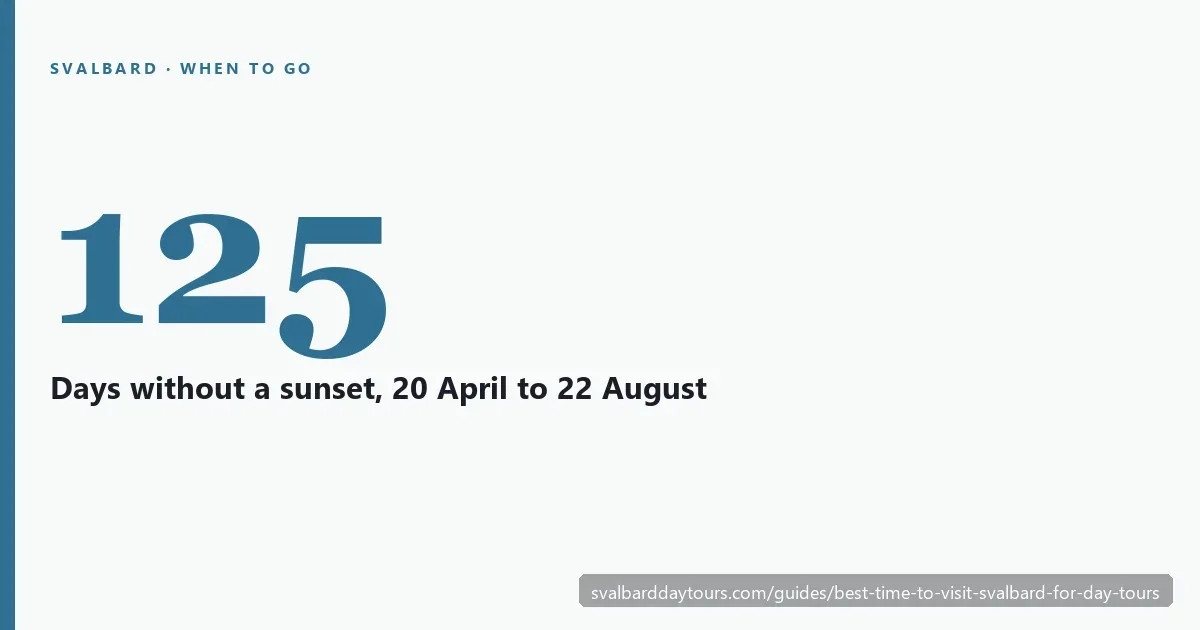
There is no single best month to visit Svalbard, because the archipelago runs three entirely different tourist seasons and they share almost no tours between them. Ice caves and snowmobiles exist from roughly November to April. Boats to the glacier fronts exist from roughly late May to September. The aurora exists from about late September to mid-March. Pick the month first and the tour list changes underneath you.
The two dates that structure everything: the polar night, when the sun does not rise at all, runs from around 11 November to 30 January. The midnight sun runs from around 20 April to 22 August — 125 consecutive days with no sunset. Below is what each stretch actually gives you.
Check Availability
Winter: November to April
This is Svalbard’s headline season and the one most people underestimate.
What is only bookable now. Ice caves and snowmobiles. An ice cave is a channel that carried meltwater through a glacier during summer and froze solid; you can walk into one only once the water has stopped and the ice is stable. In July that channel has water running through it. The snowmobile ice cave trip is the tour that genuinely does not exist at any other time of year.
The light. From about 11 November to 30 January the sun does not rise. This is not the same as darkness — around midday there is a long blue twilight that photographers travel for, and the town’s lights are on around the clock. From February the sun returns quickly, and by late March the days are long and the snow is still deep, which is why March is the month experienced visitors quietly recommend.
The temperature. Longyearbyen averages roughly −12 °C to −16 °C from January to March. Wind is what actually decides how it feels; our what to wear guide has the layer-by-layer detail.
The catch. Winter tours are the most likely to be cancelled. Book them early in your stay.
Summer: late May to September
The fjords open, and everything that floats starts running.
What is only bookable now. Boat days. The Isfjorden wildlife boat trip sails from May to October, and the longer runs to Pyramiden, Barentsburg and the glacier fronts need open water too — none of them exist in February. This is also when the bird cliffs and tundra are busiest: the richest birdlife runs from late May to mid-August, which is the sweet spot for the wildlife and photography safari.
The light. From around 20 April to 22 August the sun never sets. Tours run at hours that make no sense anywhere else — a midnight hike in full daylight is a normal booking here. Bring a proper eye mask; hotel curtains vary.
The temperature. July averages about 4.7 °C and is the warmest month of the year. That is genuinely cold for a summer, and the ground is frequently wet from May to September, which is why waterproof boots do more for you here than a thicker coat.
The catch. No aurora. The sky is never dark enough between late April and late August.
The two shoulders — and why they are the best value
Late September to early November, and late March to late April, are the two windows where the seasons overlap and the widest range of tours is bookable at once.
In late September and October the fjords are still open, the boats are still running, and the sky has gone dark enough for the aurora to return. It is the only time you can realistically do a glacier boat day and an aurora photography night on the same trip.
In late March and April the snow is still deep enough for snowmobiles and ice caves, but the sun is back and the days are long. You lose the aurora as April goes on, and you gain everything else.
If your dates are flexible and you want the most options for the money, aim at one of those two windows rather than at midwinter or midsummer.
Month by month, at a glance
| Month | Light | Ice caves & snowmobiles | Boats | Aurora |
|---|---|---|---|---|
| January | Polar night to 30 Jan | ✓ | ✗ | ✓ |
| February | Returning fast | ✓ | ✗ | ✓ |
| March | Long days, deep snow | ✓ | ✗ | ✓ |
| April | Midnight sun from ~20th | ✓ early | ✗ | Early only |
| May | Midnight sun | ✗ | From late May | ✗ |
| June | Midnight sun | ✗ | ✓ | ✗ |
| July | Midnight sun | ✗ | ✓ | ✗ |
| August | Midnight sun to ~22nd | ✗ | ✓ | ✗ |
| September | Darkening | ✗ | ✓ | From late Sept |
| October | Short days | ✗ | Early only | ✓ |
| November | Polar night from ~11th | ✓ | ✗ | ✓ |
| December | Polar night | ✓ | ✗ | ✓ |
Three tours ignore this table entirely: the coal mine, the Seed Vault and town car tour, and guided walking all run every month of the year. If your dates are fixed and awkward, those are your floor.
How many days do you need?
Three full days is the practical minimum, and four is better. Not because there is more to see — the tour catalogue is finite — but because cancellations are routine and a two-day trip has no slack in it. With three days you can lose one tour to weather and still come home having done what you came for.
If you have only one day, book something that runs year-round and cannot be cancelled. Our which-tour guide sets out the options by length.
Frequently Asked Questions
When can you see the northern lights in Svalbard?
Roughly late September to mid-March. The distinctive window is the polar night, about 11 November to 30 January, when the sun does not rise at all and the aurora can appear at any hour rather than only after sunset. There is no aurora between late April and late August — the sky is never dark.
Is Svalbard worth visiting in summer?
Yes, but for different reasons than winter. Summer gives you open fjords, glacier fronts, abundant birdlife, and 24-hour daylight that lets tours run at hours that would be impossible elsewhere. What it does not give you is aurora, snowmobiles or ice caves.
What is the coldest month in Svalbard?
March, with an average around −16 °C, marginally colder than January and February. It is also one of the best months to visit, because the light has returned and the snow cover is at its deepest.
Can you visit Svalbard in December?
Yes, and tours run through it — the coal mine, town tours, snowmobiles and aurora chasing all operate. What you will not get is daylight. December sits in the middle of the polar night, so plan for a trip built around interiors, headlights and the sky.
Is the midnight sun disruptive?
For sleep, often. Bring an eye mask and do not rely on the curtains. For touring it is a gift: a hike at 11pm in full sun is a normal Svalbard booking, and the light in those hours is better than at midday.
Stand at the Door of the Global Seed Vault
Two hours by car to the concrete wedge in the mountainside, out through Adventdalen where the reindeer graze, and round Longyearbyen's mining heritage. Hotel pickup and a warm drink included — and it runs every month of the year.
Check Availability & Book